 Health · Beacon Post
Expertise became disdained in government and commerce. Now we’re paying the price in outages and breakdowns It may be recalled, if you have a memory that stretches back a mere four decades or so, that Michael Dukakis, the Massachusetts governor running for president against George H.W. Bush in 1988, was universally ridiculed for saying that the watchword of his administration would be “competence.” One could take that moment as a milepost in America’s long slide into distrust of expertise and professionalism.
That chicken now has come home to roost in the guise of a breakdown in technological systems in government and business, but it has been fluffing its feathers for a long time. What we’re seeing evokes the lament of a character in Hemingway’s “The Sun Also Rises,” about how he went bankrupt: “Two ways — gradually, then suddenly.” Gradually, our air traffic control system and others like it deteriorated, almost invisibly, even as they took on an ever increasing role in our daily lives. Over the last two weeks, they’ve come to pieces, and suddenly.
The world’s enormous installed base of software, much of it old, poorly maintained, and deeply interconnected, is a soft target. — Investor and technologist Paul Kedrosky The truth has been simmering under the surface for years, in business and government. Corporate overseers of increasingly complex systems have skimped on maintenance and upkeep, because those are expense categories. “Security, safety, resilience, redundancy and recoverability are all essential parts of reliable technology, but they are all costs ,” writes security expert Bruce Schneier.
“More importantly, they are costs that don’t generate near-term profits.” As long as breakdowns in mission-critical programs occurred at manageable intervals, “good enough” was, well, good enough. But years of deferred maintenance are taking their toll. “The world’s enormous installed base of software, much of it old, poorly maintained, and deeply interconnected, is a soft target ,” observes investor and MIT research fellow Paul Kedrosky.
He’s right, but his observation points to the questions: Who let the systems get that way, and why? The surge in outages has people searching for patterns. The two favored conspiracy theories blame artificial intelligence and hackers (chiefly foreign).
It’s fair to say that the breakdowns, taken individually, are theoretically consistent with either explanation. But it’s probably true that the outages are unconnected, which would rule out any coordinated attack. Also, temporary outages of technological systems at banks and airports have become so familiar that had the individual outages occurred two weeks ago they might not even have made the newspapers, much less received front-page coverage.
But when they all come together, exemplified by the eye-opening grounding of all passenger planes in the U.S., they get treated as elements of a single occurrence. Yet one doesn’t have to search for nefarious conspiracies to find a common factor in all these cases: It’s incompetence. Incompetence takes many forms.
In business, it can manifest as inattention. Consider the outage generally cited as the first in the recent timeline, which rendered Microsoft’s Outlook email and several other services inaccessible for more than a day, starting late on Nov. 12 and lasting into Nov. 14. Microsoft blamed the breakdown partly on “a latent defect” dating back several months in its network system software.
The defect’s importance went unnoticed, the company says, because its testing focused on older systems, not newer hardware. (I asked Microsoft whether the breakdown reflected managerial incompetence but didn’t get a reply.) Chronic underinvestment in software upgrades is a business failing. The breakdowns in government performance derive from a different kind of incompetence. President Trump has mounted a concerted attack on government expertise, concealed behind a supposed efficiency drive.
In Elon Musk’s ugly DOGE assault on the federal workforce, the targeted firings and terms of the voluntary separation come-on were deliberately designed to push out STEM (science, technology engineering and math) workers and those with more education, a team of researchers from the Accounability and Reform Research Consortium reported in August. The loss of human capital and institutional knowledge is incalculable, they wrote. The experienced workers who departed were either not replaced at all, or replaced by know-nothing incompetents.
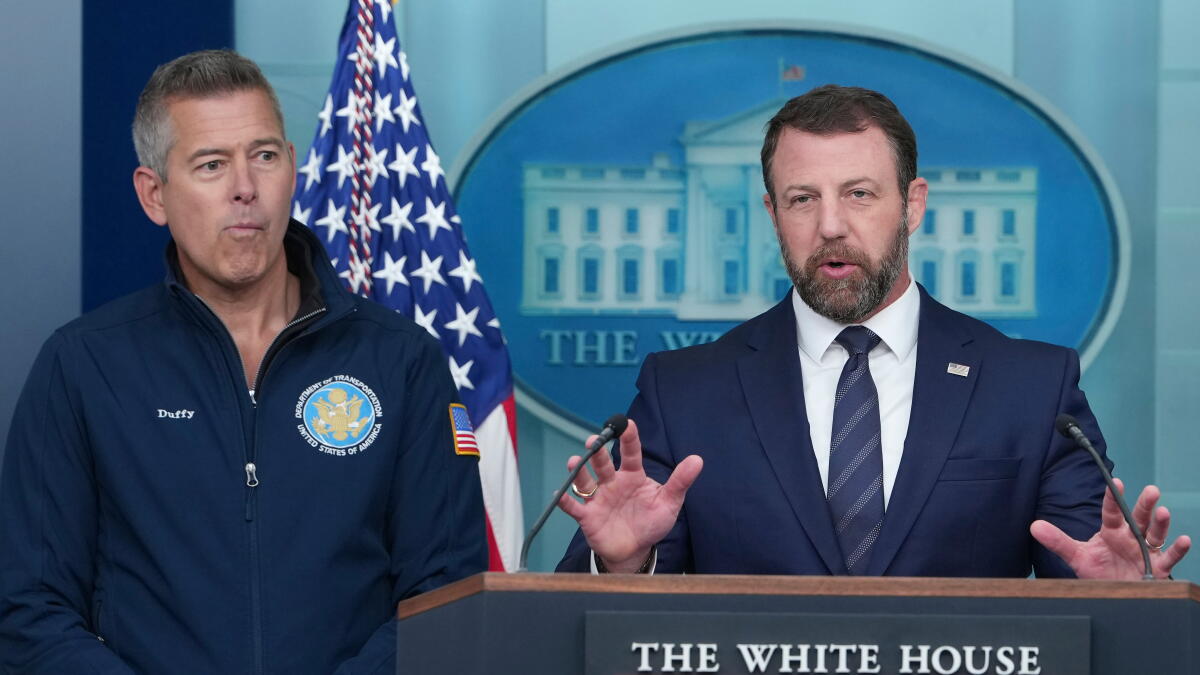
The researchers described the outcome not as “downsizing,” but “dumbsizing.” Trump has stuffed his Cabinet with unqualified members who seem to view their government jobs as activities to fill in the empty hours between joyrides at taxpayer expense. The front men in the calamitous Nov. 20 grounding of the nation’s entire fleet of commercial and private aircraft, Transportation Secretary Sean Duffy and Homeland Security Secretary Markwayne Mullin, are representative of the incompetent administrators inhabiting the Trump circle. At a joint news conference with Mullin after the Feb. 20 ground stop was lifted, Duffy maintained that the chief problem faced by the Federal Aviation Administration is a lack of congressional funding, and described the safety of the air traveling public as “ our number one priority .” Is that so?
In 2019, when he was a congressman from Wisconsin, he voted against a measure to fund the FAA, among other agencies, during a government shutdown. A Duffy spokesperson noted that he had voted in favor of FAA funding on other occasions, but the 2019 measure actually passed the House with 12 Republican votes, just not his. (It was killed by the Republican Senate.) Upon taking office, Duffy spent seven months filming a family car trip for a reality TV series. His spokesperson said that Duffy spent only 21 days actually before the cameras over that period, but that’s irrelevant — the production of a TV show involves a lot more than sitting around with a camera in your face, so it’s a safe bet that the project took up much more of his time than 21 days, time that he didn’t spend focused on job one, the safety of the traveling public.
While Mullin was a GOP congressman from Oklahoma, President Biden proposed an infrastructure bill with $25 billion earmarked for air system upgrades. He voted against it, along with 200 of his GOP colleagues. The day after the ground stop was lifted, and while thousands of passengers were still stranded at airports, he displayed his devotion to his government job by jetting off in a government plane to Baton Rouge for a college football game.
Still, it is Health and Human Services Secretary Robert F. Kennedy Jr. who outdistances the field in incompetence. On his watch the nation is experiencing its worst outbreak of measles since 1991, with 5,838 cases of the potentially deadly disease so far this year in 46 states and the District of Columbia.
State health agencies have reported 12 deaths from measles this year, the most in more than 30 years by the reckoning of the health policy group KFF. An international public health organization had declared measles eliminated in the U.S. in 2000. It withdrew that designation on Nov. 16 .
Last week, on X, Kennedy promised to “ stop measles outbreaks , protect American families, and work to regain U.S. measles elimination status.” He also wrote, “I continue to recommend MMR vaccination as the most effective way to prevent measles.” (MMR is the combined measles, mumps and rubella vaccine in broad use today.) Yet Kennedy cannot escape blame for the measles catastrophe. He brought to his agency a ferocious anti-vaccine record, including purveying the long-refuted claim that the MMR vaccine contributes to autism. In 2025, Kennedy summarily fired the 17 public members of the expert Advisory Committee on Immunization Practices of the Centers for Disease Control and Prevention, or ACIP.
He filled the one of the nation’s most important independent committees with anti-vaccine activists, a disastrous dumbsizing of the U.S. public health infrastructure. Trump is a past master at denigrating expertise. There’s no mystery why: When experts are ushered off the field, no one is left to raise facts to challenge received wisdom or rule by fiat, Trump’s stock in trade.
After all, he declared in 2016, “I love the poorly educated.” He knew something. Independent bodies like ACIP were created in the 18th century “to deliver expert rational policy making and independent judgment,” Noah Feldman of Harvard wrote recently. “In their place, we are getting personal rule by personal whim.” If these whims were based on competent judgment, we might have been all right.
In this government, they’re not, and the nightmare we’re living through is the harvest. More to Read
Source: Los Angeles Times